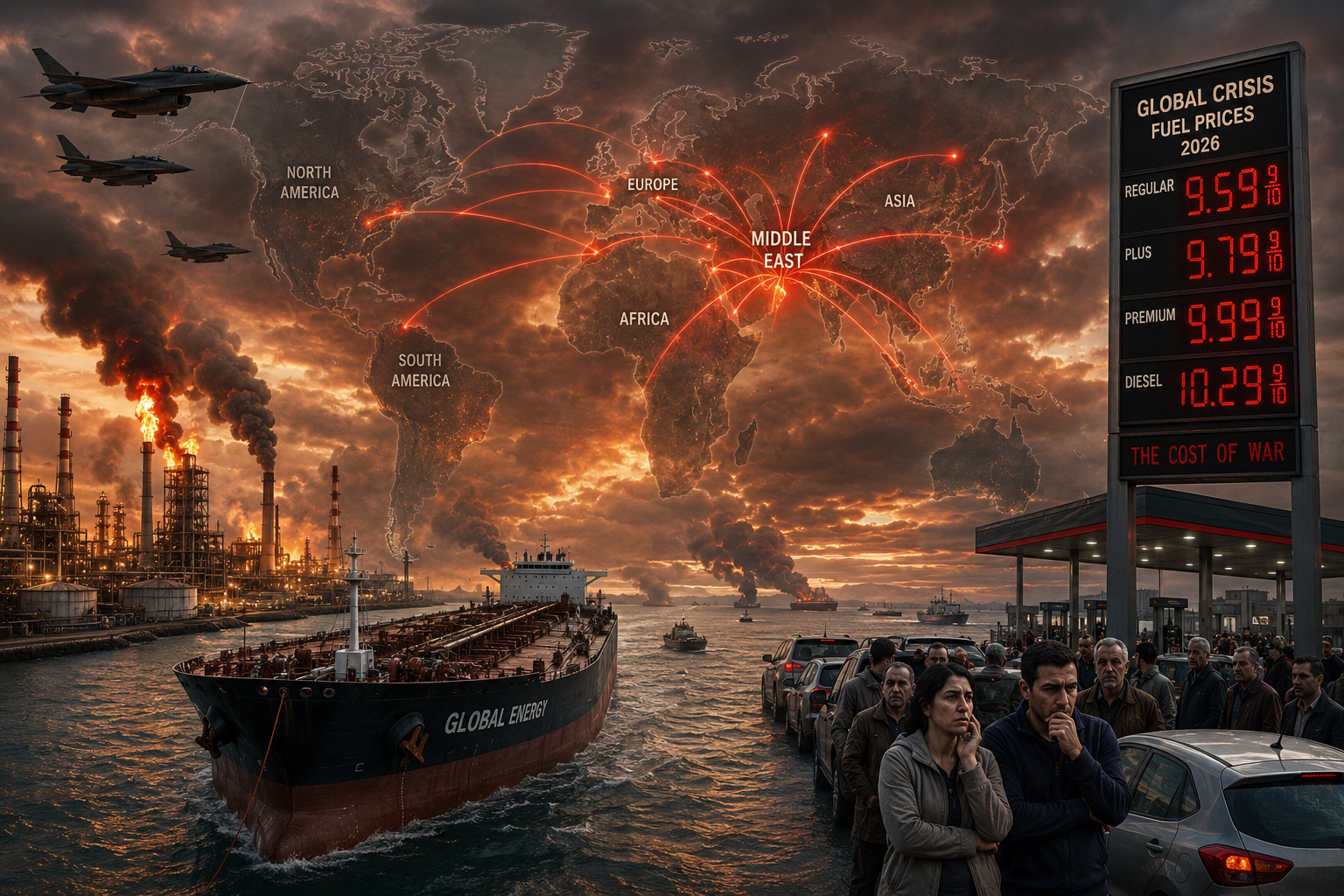
Middle East Conflict 2026: There’s a moment every morning in Lagos, London, and Los Angeles when millions of ordinary people do something they’ve never done before — they check the oil price before they check the weather.
That’s the world we’re living in now.
Since late February 2026, the Middle East has been the center of a military conflict that has unleashed what the head of the International Energy Agency called “the greatest global energy security challenge in history.” A joint U.S.-Israeli military campaign against Iran ignited not just a regional war — it sent a shockwave through every fuel pump, grocery store, shipping lane, and family kitchen on the planet.
The ripple effects are impossible to overstate. Energy prices are projected to surge by 24% this year alone, according to the World Bank. Brent crude oil, which opened in 2026 at around $69 a barrel, rocketed to nearly $120 at its peak. Fertilizer costs are forecast to jump 31%. Up to 45 million additional people could face acute food insecurity as a result of the conflict, according to the World Food Programme.
This is the story of how a war in the Persian Gulf became everyone’s problem — and what it means for the months ahead.
What Happened? The Crisis That Changed Everything
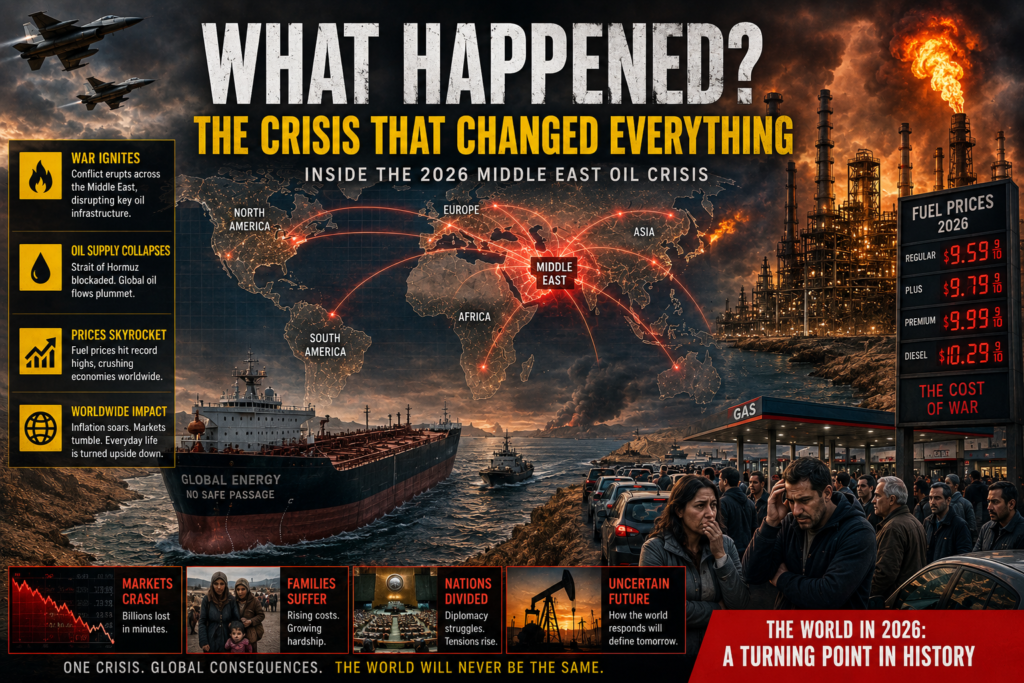
The 2026 Middle East conflict began in the early hours of Saturday, February 28, when the United States and Israel launched a coordinated military operation against Iran. Codenamed “Operation Epic Fury” by the U.S. military, the strikes targeted Iranian leadership, military infrastructure, and, in what was a defining moment of the crisis, resulted in the assassination of Supreme Leader Ali Khamenei.
Because it was a Saturday, oil markets were closed when the strikes began. When they reopened the following Monday, the reaction was immediate and brutal. Crude prices surged as traders scrambled to assess the full scale of what had just happened.
Iran’s response came swiftly. Tehran launched missile and drone strikes against U.S. and Israeli targets, as well as against Gulf states hosting American forces. Then came the move that sent shockwaves across every major economy on Earth: Iran announced the closure of the Strait of Hormuz.
That narrow waterway — just 21 miles wide at its tightest point — is the jugular vein of global energy supply. Roughly 35% of the world’s seaborne crude oil passes through it every single day. When Iran began attacking ships and energy facilities in the region, and when navigation through the Gulf ground to a near halt, the consequences unfolded with terrifying speed.
How the Crisis Escalated
What made this conflict different from previous Middle East flare-ups was the sheer breadth of its initial impact on energy infrastructure.
Within the conflict’s first two weeks, Iranian oil facilities had been struck for the first time, the United Arab Emirates, Iraq, and Kuwait were cutting output due to storage constraints and security fears, and Qatar — the world’s largest LNG exporter — had seen its output collapse. As the International Energy Agency (IEA) reported, global oil supply plummeted by more than 10 million barrels per day in March, falling to 97 million barrels per day — the single largest oil supply disruption in recorded history.
Iran’s new Supreme Leader, Mojtaba Khamenei, son of the late Ayatollah, took power amid the chaos. A ceasefire was announced on April 8, 2026, providing brief relief to markets. But the Strait of Hormuz remained subject to a U.S. naval counter-blockade even after the ceasefire, and tensions between Washington and Tehran continued to flare. As recently as May 11, Israeli Prime Minister Benjamin Netanyahu warned the world that the conflict with Iran “was not over,” and U.S. President Donald Trump publicly rejected Iran’s peace counterproposal, posting that it was “TOTALLY UNACCEPTABLE.”
As of this writing, Brent crude is trading around $100 per barrel — still roughly 45% above where it started the year.
The Countries Involved: More Than Just Two Sides
This is not a simple two-party conflict. The Middle East conflict 2026 has drawn in — directly or indirectly — a cast of nations whose involvement shapes the global stakes.
The United States launched the initial strikes and has maintained a naval presence in the region, effectively blockading Iranian ports. President Trump’s rhetoric has ranged from offering olive branches to threatening to destroy Iran’s “whole civilization.”
Israel participated in the joint military operation and has continued to signal military readiness, with Netanyahu’s statements keeping markets on edge.
Iran has retaliated militarily, closed the Strait of Hormuz to commercial shipping, and continues to navigate a devastating economic crisis at home. Its currency, the rial, has collapsed to approximately 1.77 million per U.S. dollar — compared to about 830,000 a year ago.
Yemen’s Houthis have re-entered the picture, launching missiles at Israel and threatening further attacks on U.S. and Saudi infrastructure — adding another destabilizing layer to an already fragile region.
Gulf States, including the UAE, Iraq, Kuwait, and Qatar, have all seen energy output disrupted, supply chains severed, and economic forecasts downgraded.
Pakistan has emerged as a surprising diplomatic actor, offering to mediate between the U.S. and Iran, with talks reportedly making some progress.
Beyond the region, nations as varied as India, Canada, Kenya, Sri Lanka, and the United Kingdom are all grappling with the consequences in their own ways — because in a globalized economy, a war over the Strait of Hormuz belongs to everyone.
The Impact on Global Oil Prices: A Timeline of Shock
To understand just how severe the oil market crisis has been, it helps to follow the numbers in sequence.
Brent crude started 2026 at around $69 per barrel — already elevated by geopolitical uncertainty, but manageable for most economies. Then February 28 arrived.
- March 9: Brent surged near $120 a barrel as Iranian oil facilities were struck for the first time. President Trump, remarkably, described this as “a small price to pay.”
- March (full month): Brent crude jumped 51% — one of the largest single-month oil price gains ever recorded.
- Peak disruption: Physical crude oil prices — the real-world prices refiners actually paid to secure barrels — surged to record levels near $150 per barrel, far above the futures markets, as desperate buyers scrambled for any available supply.
- April ceasefire: Prices dipped below $100 briefly as diplomatic signals improved.
- May 11 (today): Brent is back above $100 as Netanyahu’s “not over” warning reverberates through trading floors.
The World Bank now forecasts Brent to average $86 a barrel for the full year of 2026 — but warns that if hostilities escalate or the Strait of Hormuz remains restricted longer than expected, prices could average as high as $115 a barrel.
According to the IEA’s April Oil Market Report, tanker traffic through the Strait may have fallen by more than 90% during the peak disruption period. Asian refineries, cut off from their primary feedstock, slashed production by around 6 million barrels per day. Global crude runs are now expected to decline by 1 million barrels per day on average across 2026.
Impact on Businesses: From Airlines to Farmers
When the oil market sneezes, the global business community gets pneumonia.
The industries feeling the sharpest pain are many and varied:
Airlines have been among the hardest hit. Flight cancellations across the Middle East, parts of Asia, and Europe have caused a sharp drop in jet fuel consumption — not because demand has disappeared, but because supply has been disrupted and costs have spiraled. Several carriers have imposed fuel surcharges, and some regional routes have been suspended entirely.
Shipping and logistics companies are facing soaring war-risk insurance premiums and rerouting costs. Vessels that previously transited the Persian Gulf are now taking long detours around the Cape of Good Hope, adding weeks and high costs to journeys that once took days. These costs, inevitably, are passed on to customers.
Petrochemical and manufacturing industries, particularly in Asia, have been hit by feedstock shortages. Asian petrochemical producers have curtailed operating rates sharply as LPG and naphtha supply dried up. This flows directly into higher costs for plastics, packaging, textiles, and electronics.
Agriculture is facing a compounding crisis. Fertilizer prices are projected to surge 31% in 2026, driven by a staggering 60% jump in urea prices. This is because much of the world’s fertilizer supply originates in or transits through the Persian Gulf. In Canada, Chile, India, and sub-Saharan Africa, farmers are already seeing input costs soar — which means lower yields, higher food prices, and in the most vulnerable regions, hunger.
Tech supply chains are not immune either. Oxford Economics researchers have warned that a prolonged Iran conflict puts AI supply chains at risk, as rare materials and components critical to data center manufacturing pass through disrupted trade routes.
Meanwhile, British manufacturers are deeply pessimistic: a Confederation of British Industry survey from April 2026 found that more manufacturers expected output to decrease over the next three months than to increase — by a margin of 20 percentage points.
Impact on Everyday People: A Cost-of-Living Shock
Abstract economic statistics become very concrete very quickly when you’re standing at a petrol station or a supermarket checkout.
In the United States, gas prices have surged past $4.00 a gallon. U.S. inflation is projected to average 3.2% in 2026 — a sharp climb from forecasts made at the start of the year. The Federal Reserve, which had been cautiously managing interest rate policy, now faces the prospect of stagflation — rising prices combined with weakening growth — which severely limits its options.
In the United Kingdom, inflation jumped to 3.3% in March 2026, up from 3.0% in February, with motor fuel prices the single largest contributor to that increase. The Food and Drink Federation has revised its UK food inflation forecast to over 9% by the end of 2026 — up from just 3% forecast in January. The IMF cut the UK’s GDP growth forecast to just 0.8% for 2026, the sharpest downward revision of any G7 economy, noting that Britain is “more exposed to energy price shocks” than its peers.
In Kenya, the Energy and Petroleum Regulatory Authority announced record fuel price surges in mid-April. Public transport operators responded by hiking fares by roughly 25%, which immediately raised costs for basic goods and services in a country where many families already spend the majority of their income on food and transport.
In Sri Lanka — a nation still recovering from a devastating economic crisis — authorities raised LPG prices by 8% on March 11, just a day after increasing fuel prices by a similar percentage. For families cooking on gas stoves, every price hike is a daily negotiation between eating and heating.
In India, the crisis has been particularly multifaceted. The country sources nearly 60% of its petroleum imports from the Persian Gulf and relies on the region for over $125 billion in annual remittances from its diaspora. With fertilizer supply chains disrupted — India imports over 40% of its urea and phosphate from the region — three urea production plants have already been forced to reduce output.
And then there is Iran itself, where the human cost of the conflict is most acute. Food inflation surged to over 105%. The price of cooking oil rose by more than 200%. Bread and cereals are up 140%. The rial has lost more than half its value in the space of a year. Workers earning the minimum wage take home the equivalent of roughly $104 per month. “There is no work and our savings are gone,” one Iranian citizen told Iran International. Another said simply: “We cannot pay rent, we cannot work.”
These are not statistics. These are people.
Expert Opinions and Global Reactions
The world’s leading economic institutions have been unusually blunt in their assessments of what this crisis means.
World Bank Chief Economist Indermit Gill warned: “The war is hitting the global economy in cumulative waves: first through higher energy prices, then higher food prices, and finally, higher inflation, which will push up interest rates and make debt even more expensive. The poorest people, who spend the highest share of their income on food and fuels, will be hit the hardest.” He added a phrase that carries the weight of a verdict: “War is development in reverse.”
The IMF has cut its global growth forecast to 3.1% for 2026. In developing economies, inflation is now projected to average 5.1% this year — a full percentage point above what was expected before the war began. Those are the economies least equipped to absorb the shock.
The IEA has described the disruption as the “greatest global energy security challenge in history” — more severe, in its immediate oil supply impact, than the 1973 Arab oil embargo or the 1979 Iranian Revolution.
At the Council on Foreign Relations, analysts have pointed to the compounding nature of the crisis: it isn’t just energy — fertilizer and high-tech supply chains are also tangled in the disruption, widening the crisis far beyond what oil alone would suggest.
Citi analysts writing this week noted that crude markets have been partially cushioned by high inventories and strategic petroleum reserve releases, but warned that risks to prices remain “tilted to the upside,” as Iran retains significant control over the timing and terms of any deal to reopen the Strait of Hormuz.
What Could Happen Next? Scenarios for the Months Ahead
The honest answer is: nobody knows for certain. But analysts and institutions have sketched out several plausible paths.
The optimistic scenario assumes that the ceasefire holds, diplomatic talks brokered by Pakistan make progress, and shipping through the Strait of Hormuz gradually resumes toward pre-war levels by late 2026. Under this scenario, the World Bank projects Brent crude averaging $86 a barrel for the full year — painful, but manageable for most developed economies.
The baseline scenario acknowledges significant uncertainty. Citi analysts expect the Strait to reopen around the end of May, but warn that any deal is likely to involve a “partial reopening” — meaning disruptions could persist for longer than markets are pricing in.
The pessimistic scenario is harder to read without feeling a chill. If Iranian oil and gas facilities suffer more extensive damage, if the Strait remains restricted beyond the summer, or if the Houthi threat in Yemen escalates further, Brent crude could average as high as $115 a barrel in 2026. Under that scenario, global food insecurity could push up to 45 million additional people into crisis. Developing economies — already stretched — would face deeper recessions. And the human cost, which is already immense, would grow further.
On the political front, Trump’s rejection of Iran’s peace counterproposal today adds fresh uncertainty. Netanyahu’s warning that the conflict is “not over” suggests that even in ceasefire conditions, the threat of renewed escalation remains real.
One thing analysts broadly agree on: the era of cheap, predictable energy — already strained by climate concerns and the Russia-Ukraine war — may now be over for good. The Middle East conflict of 2026 has accelerated a structural shift in how the world thinks about energy security, supply chain resilience, and geopolitical risk.
Conclusion: The Price We All Pay
Wars are fought with weapons. But their costs are paid by everyone.
The Middle East conflict of 2026 is, at its heart, a geopolitical and military confrontation between powerful states over strategic dominance in one of the world’s most critical regions. But in practice, it plays out in the price of bread in Tehran, the cost of a bus fare in Nairobi, the fuel bill of a small business owner in Birmingham, and the grocery receipt of a family in Chicago.
The numbers are staggering. The largest oil supply disruption in history. Energy prices are surging toward their highest levels in four years. Forty-five million people are potentially pushed toward acute hunger. A global growth forecast of just 3.1%.
But behind every one of those numbers is a person — often one who had nothing to do with the decisions that sparked this crisis and no power to change them.
The immediate path forward depends on diplomacy: specifically, on whether the U.S. and Iran can reach a deal that reopens the Strait of Hormuz before the disruption causes permanent economic damage. Today’s headlines suggest that the path remains uncertain.
What is certain is that the world is watching — and that how this ends will define the economic landscape for years to come.
Sources: World Bank Commodity Markets Outlook (April 2026), IEA Oil Market Report (April 2026), Council on Foreign Relations, IMF World Economic Outlook, CNBC, Al Jazeera, Iran International, UK House of Commons Library, The Final Call Digital.
Disclaimer: This article reflects verified information available as of May 11, 2026. The situation remains fluid. Always consult multiple news sources for the latest developments.